Back when Fukushima had it's issues due to an earthquake moving the entire island of Japan 8 feet over, Randall Munroe over at XKCD had not yet gone off the rails, and posted an interesting and highly useful infographic on radiation levels.
For people who hadn't been trained in radiation dosimetry, it certainly is a damned useful way to visualize the degree of hazard associated with the radiation released from Fukushima when broke down.
This blog has moved to https://thelastredoubt.com. Old articles will remain here for those who have linked to them.
Showing posts with label xkcd. Show all posts
Friday, February 10, 2017
Monday, September 19, 2016
"No Evidence..." and Other Bullshit
First - I was wrong. I wrote that I "have yet to hear insistence that Islam had nothing to do with it." - and I hadn't - but only because I didn't dig further into the official statements by Cuomo, de Blasio, etc. We're getting responses like:
And it's all bullshit.
I get it, if we don't know, we don't fucking know, but then the only four words we have to say are "we don't know yet". Meanwhile, there's also no evidence it was white supremacists, the Amish Sepratist Front, or Leprechauns, but there damn well is reason to believe it had something to do with Islam.
Look, one major tell someone is bullshitting you is when they use a lot more words than are needed. They're trying to hide something, talk around something, misdirect you from something, but more importantly, obscure something like a needle in a haystack and distance you from what they're saying (it's George Carlin, worth watching). Yes, we geeks are often accused of overspeaking when trying to be precise, and very smart people of "using big words to show off" - but there is a difference, in cadence, in feel when someone is bullshitting you (Aside - the Harry Frankfurt book "On Bullshit" is worth reading, and he also has an online essay).
In the above cases we get handed a bunch of words that are - sometimes only in the barest technicality (what counts as "evidence"?) - true, but intended to sell you a lie, minimize the problem, make you believe a falsehood.
I've been told "But they don't know for sure so they can't say it was terrorism" - much like the news is trying to slam Trump for saying "bombing" before the official statement was made. Again - bullshit. if they don't know, those are the only three words they have to say. Every extra word in those statements, especially prepared ones, has a purpose - so look, again, at what they're minimizing.
And how did Trump "know" it was a bombing? How did we figure it wasn't a radicalized Mennonite?
Bomb experts will analyze the device and how it was made, according to CNN senior law enforcement analyst Tom Fuentes.Even better, de Blasio:
"It could be somebody that has grievance against the US military, possibly the Marine Corps specifically, and have nothing to do with an overseas-inspired attack like ISIS. So it still could be terrorism without being international, without being al Qaeda or ISIS or another affiliated group."
During a press conference, New York Mayor Bill de Blasio said that there is no evidence that the explosion in Manhattan had any terror connectionSimilar statements are being made, that it's not certain it was terrorism, etc.
And it's all bullshit.
I get it, if we don't know, we don't fucking know, but then the only four words we have to say are "we don't know yet". Meanwhile, there's also no evidence it was white supremacists, the Amish Sepratist Front, or Leprechauns, but there damn well is reason to believe it had something to do with Islam.
Look, one major tell someone is bullshitting you is when they use a lot more words than are needed. They're trying to hide something, talk around something, misdirect you from something, but more importantly, obscure something like a needle in a haystack and distance you from what they're saying (it's George Carlin, worth watching). Yes, we geeks are often accused of overspeaking when trying to be precise, and very smart people of "using big words to show off" - but there is a difference, in cadence, in feel when someone is bullshitting you (Aside - the Harry Frankfurt book "On Bullshit" is worth reading, and he also has an online essay).
In the above cases we get handed a bunch of words that are - sometimes only in the barest technicality (what counts as "evidence"?) - true, but intended to sell you a lie, minimize the problem, make you believe a falsehood.
I've been told "But they don't know for sure so they can't say it was terrorism" - much like the news is trying to slam Trump for saying "bombing" before the official statement was made. Again - bullshit. if they don't know, those are the only three words they have to say. Every extra word in those statements, especially prepared ones, has a purpose - so look, again, at what they're minimizing.
And how did Trump "know" it was a bombing? How did we figure it wasn't a radicalized Mennonite?
Monday, September 5, 2016
Human Systems vs Machine Systems
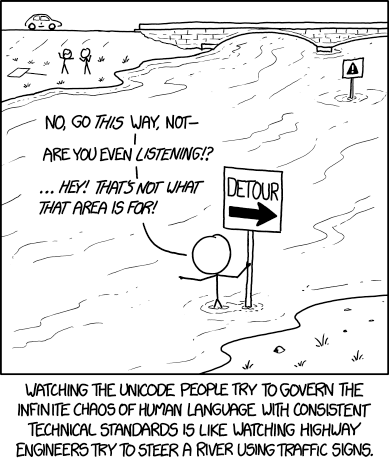
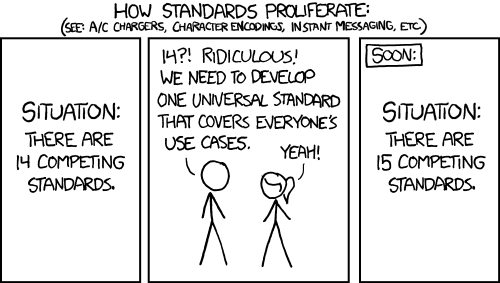
Recently at XKCD:
This is almost a perfect example of why so many computer geeks are progressives - they have faith in the ability of systems to adjust how people behave rather than adjusting those systems to how people work.
Of course reality is never that black and white.
If I'm starting up a steam turbine, or a computer, there may be leeway here and there, but certain things have to happen before certain other things. Period. In this case, people have to adapt to the system or they cannot take advantage of it.
That said, if you have a clunky design, what do you do? You start redesigning it, making it easier to manipulate - you start adapting the system to human needs, to simplify it, reducing error. Even if you can't make changes - as a nuke in the engineroom we spent countless hours rehearsing and evaluating, brainstorming, on exactly how to make the human workflow more effective, faster, more efficient, and less error-prone given the system limits we were working with, and the capabilities, personalities, strengths, and weaknesses of the people at the watch stations. In five years, no underway had quite the same startup procedure.
It's also why good teams can stand head to head with ersatz all star teams. They know each other, and where they will be.
Organically developed languages and procedures are messy - and over time, it's sometimes necessary to cut back the clutter and lay in a systemic foundation - but in starting over, or in working with what is in front of us, we should not be so arrogant as to think that we adapt the people to the system - and should focus on how to make the system, especially the workflow and set of decisions that need to be made, work for the people.
Related:
This is almost a perfect example of why so many computer geeks are progressives - they have faith in the ability of systems to adjust how people behave rather than adjusting those systems to how people work.
Of course reality is never that black and white.
If I'm starting up a steam turbine, or a computer, there may be leeway here and there, but certain things have to happen before certain other things. Period. In this case, people have to adapt to the system or they cannot take advantage of it.
That said, if you have a clunky design, what do you do? You start redesigning it, making it easier to manipulate - you start adapting the system to human needs, to simplify it, reducing error. Even if you can't make changes - as a nuke in the engineroom we spent countless hours rehearsing and evaluating, brainstorming, on exactly how to make the human workflow more effective, faster, more efficient, and less error-prone given the system limits we were working with, and the capabilities, personalities, strengths, and weaknesses of the people at the watch stations. In five years, no underway had quite the same startup procedure.
It's also why good teams can stand head to head with ersatz all star teams. They know each other, and where they will be.
Organically developed languages and procedures are messy - and over time, it's sometimes necessary to cut back the clutter and lay in a systemic foundation - but in starting over, or in working with what is in front of us, we should not be so arrogant as to think that we adapt the people to the system - and should focus on how to make the system, especially the workflow and set of decisions that need to be made, work for the people.
Related:
Subscribe to:
Posts (Atom)